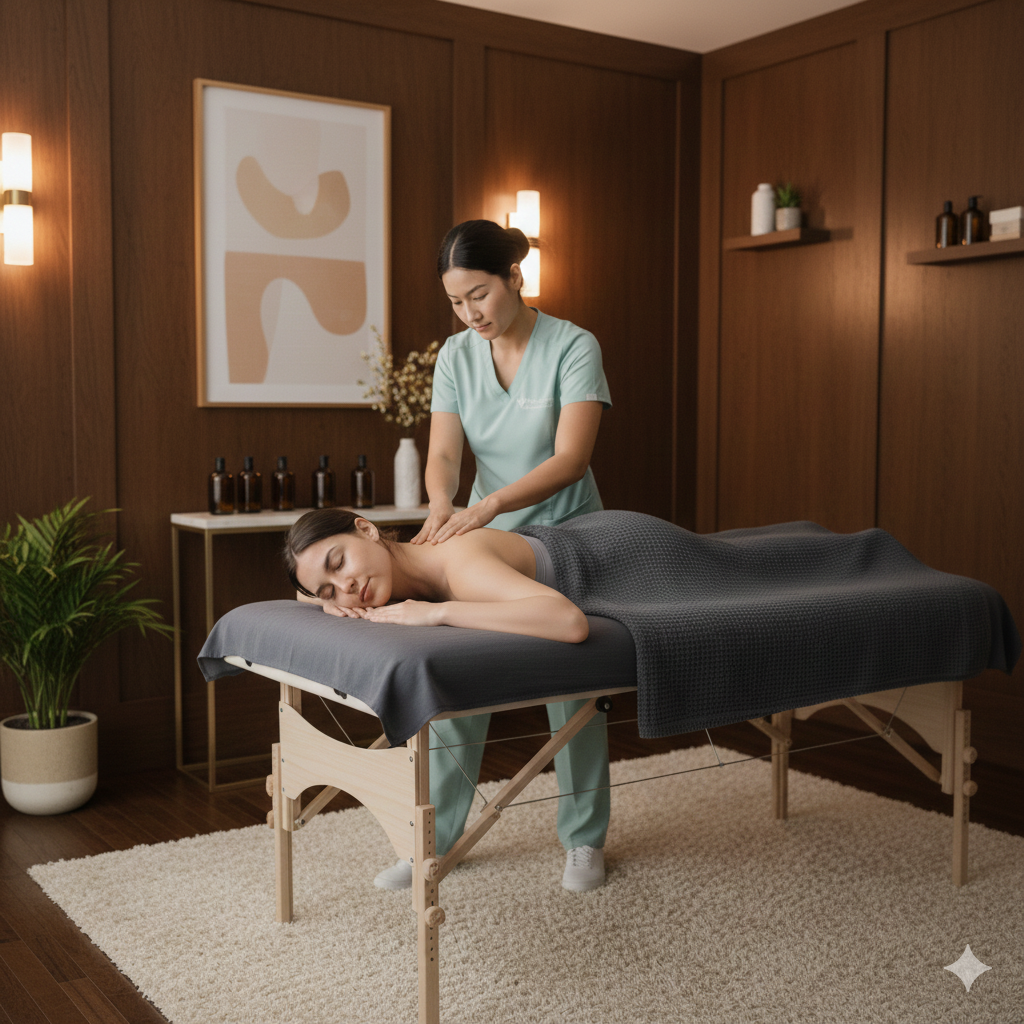
Osteopathy focuses on how the body functions as an interconnected system. Treatment may address posture, joint restrictions, movement quality, and how one area of strain affects another. Clients often book it when they feel that one recurring sore spot is only part of a larger pattern.
This service usually appeals to people who want a hands-on approach that looks at movement relationships rather than only local tension. They may notice that discomfort keeps coming back, shifts from one area to another, or seems tied to posture, gait, desk work, training patterns, or body compensation over time.
Why clients choose osteopathy
Clients often book osteopathy when they want a hands-on approach that looks beyond one sore muscle group and considers how the body is compensating overall.
What the visit may focus on
A session usually begins by looking at how symptoms behave, what movements feel limited, and whether one area appears to be overworking for another. That bigger-picture view is often what makes osteopathy feel different from a more direct soft-tissue treatment.
Clients commonly appreciate osteopathy when the problem feels mechanical, movement-based, or linked to posture and joint relationships. The goal is often to improve how the body is moving and adapting, not simply to relax one tense area for a short period of time.
Common fit
- Ongoing mobility restrictions
- Postural imbalance and movement discomfort
- Recovery plans that benefit from gentle manual assessment and treatment
When osteopathy may be the better starting point
It may be a strong first step when massage has helped temporarily but the same issue keeps returning, or when the main complaint feels tied to alignment, joint motion, or repeated compensation patterns. If you are unsure whether osteopathy or massage therapy is the better fit, contacting the clinic first can help narrow that down.
What clients are often searching for before they reach this page
Many people who end up on the osteopathy page are not searching the word osteopathy first. They are searching recurring pain, restricted movement, posture-related discomfort, or the feeling that one part of the body is always compensating for another. Osteopathy becomes relevant when the issue feels more mechanical, patterned, or movement-based than purely muscular.
For clients in Richmond Hill, Markham, Vaughan, Thornhill, Aurora, Newmarket, North York, and Scarborough, that often means they want more than temporary relief. They want to understand why the same discomfort keeps returning, whether their movement habits are involved, and whether a more whole-body manual assessment may be a better use of time than continuing to chase one sore area.
How follow-up is often approached
Some clients book osteopathy as a one-time assessment for a recurring problem. Others use it as part of a short series when movement restriction, posture mechanics, or compensation patterns have been building for a while. In both cases, the service is usually most useful when the goal is not only feeling looser for a day, but understanding how strain is organizing through the body over time.